
We have heard a lot about freedom this past week in this country. Our celebration of Canada Day is a rich national tradition that reminds us to be grateful for the freedoms with which we are blessed in Canada. I can speak and not worry that I will be persecuted for expressing my Christian convictions, even when I am critical of certain aspects of our society. Many people in our world do not enjoy this luxury. We should indeed be grateful for living in a free country.
Saint Paul offers us some insight into the Christian understanding of freedom in his letter to the community at Galatia. Disappointed in this community because some have returned to a Law-centered rather than a Christ-centered understanding of salvation, Paul exhorts them to preserve the freedom that Christ offers us.
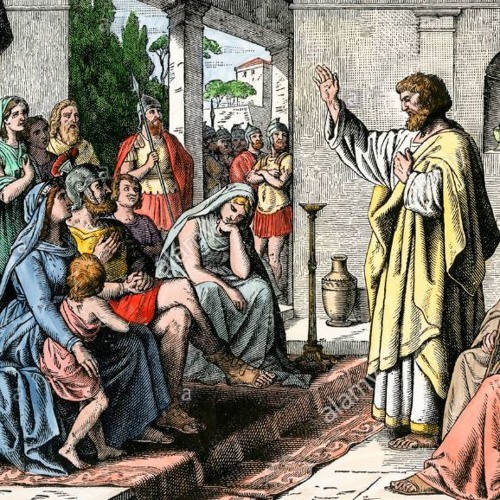
In today’s Gospel, Jesus commissions the seventy-two disciples, sending them forth to proclaim the reign of God and to heal the sick. “The Lord appointed seventy-two others.” This is a fact that we can easily overlook in a superficial reading of the Gospel. Jesus did not choose the twelve apostles to be his exclusive envoys to the world. In fact, he selected a much broader group of followers. Even the numbers have a specific meaning. Twelve was the number of the tribes of Israel and seventy-two was considered the number representing the Gentiles. Jesus is symbolically saying that he is sending out emissaries to every part of the world, that is, “to every town and place he himself intended to go.” Some of the Church Fathers suggest that when Jesus went up the mountain to pray for those he would choose as his disciples, he not only prayed for the twelve apostles but for every disciple he would ever call. Including each one of us.
Jesus exclaims: “The harvest is plentiful, but the laborers are few; therefore, ask the Lord of the harvest to send out labourers into his harvest.” Jesus called his disciples, and he calls you and me, to live the freedom he has given us through a life of service to others. We are invited to proclaim the reign of a loving, merciful God in word and action. Christ empowers us to be free for one another.
Every member of the Church is called to be a living stone, an active apostle in the building of the Kingdom of God.
The word “Apostle” means an envoy, emissary, someone who is sent on a mission or given a charge, an order, a mandate. Just as Jesus in today’s gospel gives instructions to the seventy-two missionaries he also gives each of us a mission to carry out in our own lives. Let me suggest three areas of mission that we might consider:
First: To build the Church. Not my idea of what the Church should be, not my illusion of the perfect faith community with flawless members and angelic liturgies; the Church founded by Christ on the rock of Peter, a humble, ignorant fisherman who denied Christ, who lost all hope after the crucifixion and who fled from persecution but who later faced the Pharisees and learned to love his own enemies; who humbly accepted the help and advice of St. Paul and followed in his footsteps to Rome and died for the Lord he loved. It pales in comparison with “cafeteria Catholicism” where I pick the parts of my own personal creed according to my whims and fancies.
Second: To be a Martyr. The early writers of the Church never call the first Christians “martyrs,” in the modern sense of the word, but rather those who died “giving witness” to Christ. The most important element wasn’t their death; it was their fidelity to faith until the last moment of their life.
Of course, you’re thinking, “That’s fine for priests, nuns and religious missionaries but I’m just a normal, card-carrying Catholic.” Examine your life. Are you just an armchair Catholic, a spiritual weekend warrior, a “barely make it to Mass” member of the Church? Now ask yourself another question: Is your heart full of joy?
If the answer is anything less than “totally, completely, absolutely,” then there is definitely room for improvement. I often hear people in hospital ask:” Doctor, is it really that bad?” The most serious diseases are usually the ones that go undetected for so long, that it’s too late to provide an effective remedy. Luckily our spiritual well-being is significantly different. It’s never too late to come back to the fold or, even better, to take our Catholic commitment to a higher level.
And finally: to “make a joyful noise to God all the earth” (today’s Psalm 66). We must be wary not to confuse true Christian joy with the shallow pleasure of the happy hour or the fleeting satisfactions of human achievements. Once we begin to distinguish between mere human happiness and profound spiritual joy, we will be well on our way toward the greatest joy of all when we hear Christ tell us, “Rejoice that your names are written in heaven.” At that moment, everything else will become irrelevant.
As Saint Teresa of Avila writes: Christ has no body but yours, no hands, no feet on earth but yours, yours are the eyes with which he looks with compassion on this world. We are invited each day, as Pope Francis told us, to become the face of God’s mercy to everyone we encounter in our lives.
–Deacon Terry Murphy