

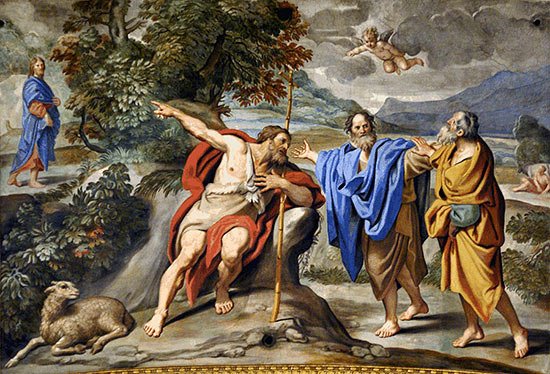
Today on this second Sunday of Advent, we meet John the Baptist. And if you’ll notice, we always meet John the Baptist this week. John is always the subject of the gospel in the second Sunday of Advent. John the Baptist is “the voice of one crying out in the wilderness… ‘Prepare the way of the Lord. Make his paths straight.’” (Mt. 3:3)
Isn’t it interesting that the gospel tells us that the Lord needs a way, a path, prepared in order to come to us? Isn’t it interesting that the Lord, God, needs something from us, God’s creation, in order to come to us in the way in which God would like. This fits in with the nature of John the Baptist’s mission – a mission of preparation. It is a beginning, not an ending.
While we are preparing to make room in our homes for more stuff, John is asking us to prepare room for God, to make room for God.
But maybe after listening to John it’s tempting to look at the advent wreath, with its two lit candles, and see the season of Advent as merely the countdown to Christmas. Let’s leave this wild man behind. We know Christmas came last year. It will come again this year just like it has for over 2000 years. It’s only a few more weeks away. So maybe we can dismiss John’s message as just another folktale. Maybe it’s the rambling of a guy who’s spent too much time by himself in the desert eating grasshoppers. Or perhaps we hear the message and think about all those other people to whom it applies. You know, the Pharisees the Sadducees and the C&E Catholics; someone other than us. But we can’t do that.
Every year in Advent, we remind ourselves, as John reminds us today, that Jesus is coming, and that means we need to repent, to change, to force ourselves into new ways of seeing the world and ourselves. Repentance isn’t just regret, it’s not just saying, “I’m sorry.” Repentance means turning down a new road, finding a new path, it means change.
John reminds us that our hope carries with it obligation. If Jesus is coming, if God has – in fact – never left us alone in the first place and will someday become real, touchable, flesh again; there are a few things we had better think about. “Repent!” John cries – “Change!” But why? What does the arrival of God, the nearness of the kingdom of Heaven, have to do with us changing?
Because, if what we do here in this life is about more than making ourselves feel good; If God is real and Jesus is coming, then everything that common sense tells us about our world and our priorities is wrong…dead wrong, because Jesus sets an entirely different standard. Wealth? It’s worthless before a savior who said, “Blessed are the poor.” Power? According to Jesus the real power lies among the meek. Success? In the kingdom of heaven, the only accomplishment that matters is loving other people.
The readings today teach that total repentance is an achievable task, but it takes time. Like Elijah, John works to bring Israel back to the Lord. Elijah called on Israel to turn away from false worship. By contrast, the Israel of John’s day had not abandoned God, but rather was abandoning hope in His promises. John called on them to turn away from weariness and return to the Lord.
In this light, John’s ministry was a fresh attempt at an ancient goal: to be ready when God fulfills his promise. John’s baptism addressed Israel’s false starts, symbolizing their willingness to try again.
The repentance of Advent is a call for transformation. How many times did Paul have to repent of hardness of heart before he realized the scriptures foretold Christ and fellowship with the uncircumcised?
Following Paul’s counsel, we who have glimpsed God’s dream must now share that hope. Like John, we have to renew the hopes of an exhausted world.
With practice, however, we can be like Isaiah, who can see beyond the mess and dream of a world in which all are ready for the arrival of God.
John dreamed of the peaceable realm and so do we. Like John, we are challenged to announce the coming of a world not yet born, critique our own and our community’s hypocrisy, and recognize that Christ’s presence demands a radical reorientation of values so that we might recognize the realm of God already emerging in our midst.
What do you find when you examine your life? What truth does St. John hold before us? What patterns of behavior destroy our lives and relationships? Which voices distract and call us away from our most authentic way of being and living? What things do we do or say that hurt others or ourselves? How do we deny or ignore our own holiness? Where in our lives have we gotten tired and lazy, unwilling to ask, seek, or knock? Do the examination, make the changes, and live a different life. Repent, change, not because we are bad, defective, or deficient but because we are worth it; because we have been created in the image and likeness of God, because God loves us, and God is coming.
Today the second purple candle is lit. This candle typically represents faith or love. It is also called the “Bethlehem Candle,” and symbolizes Christ’s manger. Focus on that candle and ponder:
- What parts of my life require more “practice?”
- If I could have a “new mind,” what would it look like?
- What has a life in the Spirit shown me of God’s dream?
- Who would benefit from hearing of this dream?
When we repent, God gives us relief from the burden of sin, because He bore that burden on Calvary. When we repent God gives us the chance to live again.
–Dcn. Terry Murphy