

How do you think you would feel if you were hungry, had no money and went up to someone on the street asking for a couple of dollars to buy some food? But, instead of helping you, the person walks right past you, ignoring your plea for help. How embarrassing would that be first to beg for help and then be totally ignored. What would you do? Would you keep on looking elsewhere?
Many things on this earth can motivate people. Peer pressure can motivate people. Guilt, greed, materialism, revenge, pride, envy, or jealousy are also strong motivators. But as you noticed in the Gospel lesson, God blesses goals that are motivated by love.
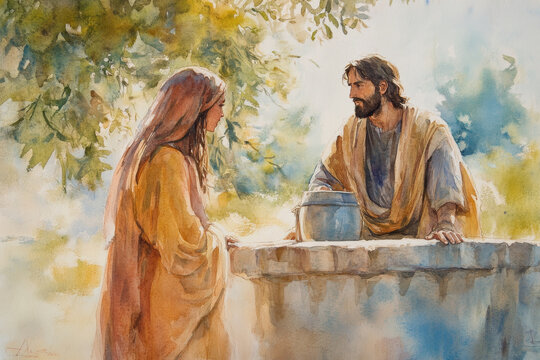
I hear the Samaritan women’s voice often when I am standing next to a deep well with no bucket, when I am facing a situation that exceeds my human abilities alone to address. Maybe you have just been given more responsibility at work (and no pay increase) and wonder how you are possibly going to be able to fulfill these obligations. The well is deep and you have no bucket. Maybe a loved one is struggling with an addiction and you feel helpless in the face of its power over them. The well is deep and you have no bucket. We may feel this way in the face of the suffering of people in our own communities, children undergoing abuse, people without healthcare, the homeless who live a hidden existence even in affluent communities. The well is deep and we have no bucket.
The woman at the well knows the value of a bucket. When she says, “You have no bucket and the well is deep,” she is making an accurate assessment of the situation on the basis of appearances. She is saying, in effect, “The task is monumental and you do not have the means to accomplish it.”
You’ve probably heard the old adage about perseverance. “When the going gets tough, the tough get going.” Humans are endowed with varying degrees of toughness – the gamut runs from insults to risk of life. I know of some people who risked incarceration to protect the unborn. Yes, there are no tougher people in this world than those who are devoted to a cause that is morally right, just, or loving.
A cartoon pictures a medieval Crusader, standing in full armor and holding his shield. He also held his long sharp spear at the throat of a prisoner on the ground. The prisoner on the ground struggles to say, “Tell me more about your Christianity. I’m terribly interested!”
That’s the picture many in this country and around the world have of evangelism. In view of Jesus’ teaching that we should love our enemies, and pray for those who use and abuse us, one can’t help but wonder why the picture of the Christian as a Crusader in armor, with sword, spear and dagger became such a popular image of a stereotypical Christian. Why is that?
We Catholics don’t want to impose our beliefs on other people. We don’t want to appear to be preachy or fanatical. It is easier to talk about a sports team or a new product than about a faith that changes our life. Why is that?
Last year the Hamilton Diocese published a booklet – Forward Together in Christ – suggesting ways to ‘reboot’ the church after the decline in attendance during the covid crisis. In the past 150 years, many Christian faiths have increasingly attempted to hire professionals to tell the story of Jesus. Across all communion lines, Christians expect people to come to Church, instead of going to the people.
What did Jesus do? Jesus had 132 contacts with people. Six were in the Temple, four in the synagogues. All the others were out in life situations. One of the accusing comments the religious leaders threw at Jesus, was He connected with people they considered to be untouchables – outcasts – little people, rejects in their religious culture.
Who better to show us how to relate Christ’s message than Jesus Himself? As He encountered men and women, He defined for us gracious, personal interaction with needy people. The woman at the Well of Samaria had deep needs. By every human standard, she’s didn’t matter to anyone. If she had dropped dead carrying water back from the well, people would barely have noticed. We don’t even know her name.
She lived in a culture that viewed women as less than fully human. They had few rights and were considered to be property. She was a Samaritan, a people despised, especially by the Jews. But, in His amazing way, Jesus transformed this woman’s life and used her as a model of personal witnessing to which He calls every Christian. What does He show us?
–Dcn. Terry Murphy